
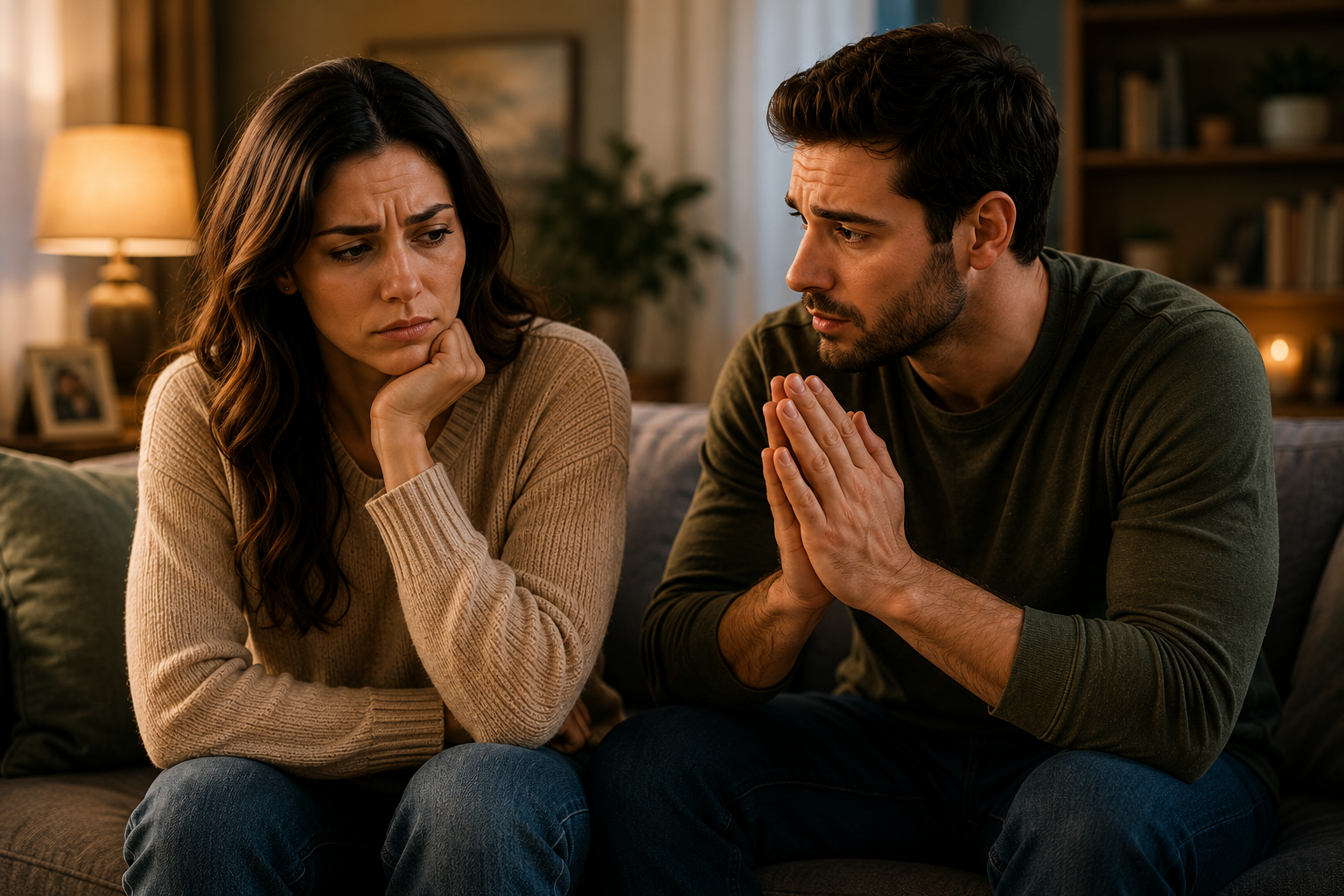
Finding out that your partner has cheated can change the way you see your entire relationship.
Even after the truth comes out, you may still be left with another difficult question:
Is my partner actually sorry for cheating, or are they only sorry that I found out?
Those two things are very different.
Someone can feel terrible because they were caught.
They can cry, apologize, promise that it will never happen again, and ask you not to leave.
But genuine remorse is more than an emotional apology.
If your relationship is going to have any chance of moving forward, you need to look beyond what your partner says and pay attention to what they consistently do.
There is no single behavior that can prove someone is genuinely sorry.
But there are several patterns that can help you distinguish real accountability from temporary regret.
Here are the signs to look for.
Quick Navigation
- They Take Full Responsibility for What They Did
- They Are Sorry for the Pain They Caused You
- They Don’t Blame You for Their Cheating
- They Stop Protecting the Affair
- They Don’t Expect You to “Get Over It” Quickly
- They Are Willing to Answer Reasonable Questions Honestly
- Their Actions Begin to Match Their Apology
- They Understand That Trust Has to Be Earned Again
- They Are Willing to Change the Behaviors That Created Opportunity for Cheating
- They Don’t Rush You Into Forgiving Them
1. They Take Full Responsibility for What They Did

One of the clearest signs of genuine remorse is taking responsibility without trying to make you responsible for the cheating.
Your relationship may have had problems.
Maybe you were emotionally distant.
Maybe you argued constantly.
Maybe intimacy had disappeared.
Maybe both of you had stopped communicating properly.
Those problems may deserve attention.
But relationship problems do not automatically make cheating your fault.
A genuinely remorseful partner can acknowledge problems in the relationship while still saying:
“I made the decision to cheat, and that was my responsibility.”
They don’t spend the entire conversation explaining why you pushed them into it.
They don’t turn your pain into an argument about your shortcomings.
And they don’t use relationship problems as an excuse to avoid accountability.
Pay attention to whether your partner accepts responsibility without conditions.
That’s often more meaningful than a dramatic apology.
2. They Are Sorry for the Pain They Caused You
There is a difference between feeling bad about consequences and feeling genuine remorse for hurting someone.
A person who is sorry they got caught might focus on things like:
- losing the relationship
- damaging their reputation
- facing uncomfortable questions
- having to explain themselves
- losing access to the life they had
A genuinely remorseful partner is also concerned about what their actions did to you.
They understand that their behavior may have damaged your sense of security, confidence, and trust.
They don’t expect you to stop hurting simply because they apologized.
Instead, they recognize that your pain is a consequence of their actions.
That kind of empathy matters.
3. They Don’t Blame You for Their Cheating
This is one of the biggest differences between accountability and excuse-making.
You may hear statements like:
“You were never there for me.”
“You stopped caring about me.”
“You made me feel unwanted.”
“Our marriage was already falling apart.”
A relationship can absolutely have serious problems.
But those problems should be discussed honestly rather than used to justify betrayal.
A partner who is genuinely sorry can say:
“We had problems, but cheating was still my choice.”
That distinction is extremely important.
If every apology eventually becomes a list of reasons why you caused the affair, the apology isn’t really taking responsibility.
4. They Stop Protecting the Affair
When someone genuinely wants to repair the relationship, they usually stop behaving as though the affair deserves protection.
That means the secrecy has to end.
If the other person is still involved, your partner needs to make their position clear.
They shouldn’t continue maintaining a hidden emotional connection while asking you to trust them again.
They also shouldn’t become angry because you want clarity about whether the affair has actually ended.
Your partner doesn’t need to provide every painful detail of the affair.
But they do need to understand that secrecy and trust cannot comfortably coexist.
If you’re still trying to determine whether the cheating has stopped, our guide What to Do After Discovering Your Partner Is Cheating: 9 Steps to Take covers the immediate steps to consider after discovering infidelity.
5. They Don’t Expect You to “Get Over It” Quickly
A genuine apology doesn’t come with a deadline.
Your partner may wish everything could return to normal tomorrow.
But you may not be ready.
And that’s understandable.
Infidelity can make you question things you once took for granted.
You may remember conversations differently.
You may wonder whether previous explanations were true.
You may have difficult days even after having several good ones.
Someone who genuinely understands the damage they’ve caused will recognize that healing takes time.
They won’t repeatedly say:
“I already apologized. Why are you still talking about it?”
Instead, they understand that an apology is the beginning of accountability—not the end of it.
6. They Are Willing to Answer Reasonable Questions Honestly
After discovering infidelity, you may have dozens of questions.
You may wonder:
- How long did it last?
- Was it emotional, physical, or both?
- How did it begin?
- Did other people know?
- Were there other lies?
- Is the relationship completely over?
- Has everything been disclosed?
You don’t necessarily need every graphic or painful detail.
In fact, some details may create more pain without helping you make a decision.
But a partner who wants to rebuild the relationship should not automatically become hostile whenever you ask reasonable questions.
They should understand why you’re seeking clarity.
Most importantly, their story should not continually change.
Repeated contradictions, unexplained gaps, or new discoveries can make an already painful situation even harder.
Honesty matters because trust cannot be rebuilt on another layer of deception.
7. Their Actions Begin to Match Their Apology
This may be the most important sign of all.
Anyone can say:
“I’m sorry.”
Real remorse eventually becomes visible through behavior.
Look for consistency.
Does your partner become more honest?
Do they respect boundaries?
Do they communicate more openly?
Do they stop hiding things?
Do they follow through on promises?
Do they show patience when you’re struggling?
Do they make changes without you having to repeatedly demand them?
You don’t need to monitor every movement your partner makes for the rest of your life.
The goal is not surveillance.
The goal is to see whether their everyday behavior gradually becomes consistent with the person they claim they want to be.
Words can start the healing process. Consistent actions give those words credibility.
8. They Understand That Trust Has to Be Earned Again
A genuinely remorseful partner doesn’t demand immediate trust.
They understand why you’re suspicious.
They understand why certain situations may make you uncomfortable.
And they don’t treat your loss of trust as though it were the real problem.
Instead, they recognize:
“I broke the trust, so I need to help rebuild it.”
That doesn’t mean your partner should live under permanent punishment.
Healthy recovery eventually needs boundaries, communication, and mutual respect.
But in the early stages, your partner needs to understand that trust is something they must patiently earn back.
If you eventually decide that you want to work on rebuilding the relationship, see How to Rebuild Trust After Cheating: 9 Things That Actually Help for the next stage of the process.
9. They Are Willing to Change the Behaviors That Created Opportunity for Cheating
Real remorse should lead to reflection.
That doesn’t mean blaming yourself for your partner’s betrayal.
It means your partner should be willing to examine their own choices honestly.
For example:
Were they constantly seeking validation from other people?
Did they ignore boundaries?
Did they hide inappropriate conversations?
Did they repeatedly put themselves in situations where boundaries became blurred?
Did they avoid difficult conversations instead of dealing with problems directly?
Whatever contributed to their decision, genuine accountability requires recognizing those patterns.
Saying “I’ll never do it again” is much weaker than being able to explain what needs to change and then actually changing it.
10. They Don’t Rush You Into Forgiving Them
Forgiveness is personal.
You may eventually forgive your partner.
You may not.
You may forgive them but still decide that the relationship isn’t right for you.
Those are separate decisions.
A remorseful partner should understand that an apology doesn’t purchase forgiveness.
They cannot demand:
“How many times do I have to say sorry?”
They also shouldn’t use guilt to pressure you into staying.
Instead, they should respect your right to process what happened.
That patience can tell you a lot about whether their apology is about your healing—or simply about getting their own comfort back.
Signs He’s Sorry He Got Caught, Not Sorry He Cheated
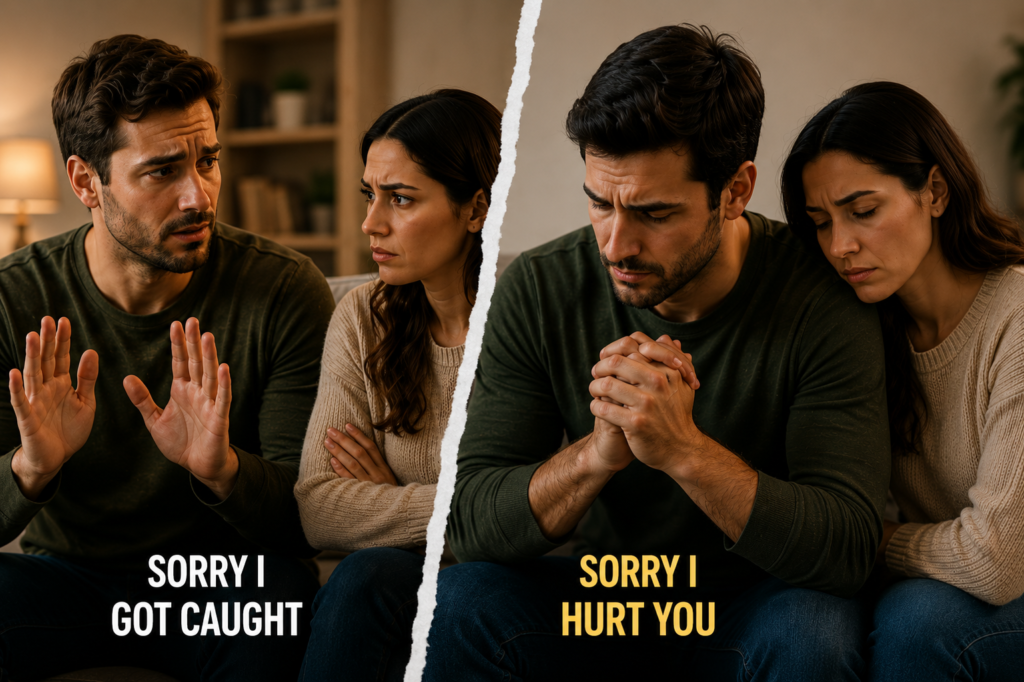
Sometimes the difference between genuine remorse and regret becomes clearer when you look at the behavior surrounding the apology.
Be cautious if your partner:
Only apologizes after being exposed
If they showed no intention of telling you and only apologized once they were caught, their remorse may still be genuine—but the circumstances deserve careful attention.
Gets angry when you ask questions
Defensiveness doesn’t automatically prove someone is lying.
But repeatedly becoming angry whenever you seek reasonable clarity can make rebuilding trust extremely difficult.
Blames you for the affair
Statements such as “You made me do it” shift responsibility away from the person who made the decision.
Wants everything to return to normal immediately
Someone may genuinely regret cheating and still feel uncomfortable with the consequences.
But if their main goal is simply to make the uncomfortable conversation disappear, that’s worth noticing.
Makes promises but doesn’t change
Repeated promises followed by the same secretive behavior are more meaningful than any emotional apology.
Continues contact with the affair partner
If the affair is supposedly over but the secret relationship continues, their actions are contradicting their apology.
Says sorry only when you’re about to leave
If remorse appears only whenever they fear losing the relationship, pay attention to what happens when the immediate crisis passes.
Genuine Remorse vs. Regret: What’s the Difference?
It can help to think of the distinction this way:
| Genuine remorse | Simple regret |
|---|---|
| Takes responsibility | Looks for excuses |
| Focuses on the hurt caused | Focuses on personal consequences |
| Accepts difficult conversations | Avoids uncomfortable questions |
| Respects your healing timeline | Wants you to move on quickly |
| Changes behavior | Makes promises |
| Accepts that trust must be earned | Demands immediate trust |
| Ends inappropriate behavior | Continues secrecy |
| Shows consistency over time | Acts differently only during a crisis |
Of course, people are complicated.
Someone can feel genuine remorse and still make mistakes while trying to change.
You are not looking for a perfect performance.
You’re looking for a consistent pattern of accountability and change.
What If Your Partner Really Is Sorry?
Even if you believe your partner is genuinely sorry, you still don’t have to decide immediately whether to stay.
Genuine remorse is important.
But it is only one part of the bigger picture.
You also need to consider whether the relationship can become emotionally healthy again.
Ask yourself:
Do I still want this relationship?
Can I eventually imagine trusting this person again?
Is my partner willing to do the work required to repair the damage?
Are we both willing to communicate differently?
Do I feel emotionally safe in this relationship?
Those questions are different from simply asking whether your partner feels guilty.
If you’re wondering whether your relationship itself has a realistic future after infidelity, read Can a Relationship Survive After Cheating? 10 Questions to Ask.
That article focuses on whether the relationship can survive, while this one focuses specifically on recognizing genuine remorse.
What If You Still Don’t Believe Their Apology?
You don’t have to force yourself to believe someone simply because they say they are sorry.
Trust doesn’t return because someone says:
“Believe me.”
It returns gradually when behavior becomes trustworthy.
Give yourself permission to observe.
Watch what happens over time.
Does your partner remain patient?
Do they continue being honest when nobody is asking questions?
Do they respect your boundaries even when doing so is inconvenient?
Do they accept responsibility months later, rather than only during the initial crisis?
Those patterns can tell you much more than one emotional conversation.
Can Someone Truly Regret Cheating and Still Cheat Again?
Yes.
Feeling guilty after cheating does not automatically guarantee that someone will never repeat the behavior.
People can experience regret and still fail to change the patterns that led to the betrayal.
That’s why remorse should not be judged by emotion alone.
Someone can cry sincerely and still repeat the same choices later.
The stronger sign is long-term behavioral change.
Genuine remorse should eventually show up in the way someone handles boundaries, honesty, communication, temptation, conflict, and responsibility.
That’s why time matters.
How Long Does It Take to Know If Someone Is Truly Sorry?

There is no universal timeline.
You may notice genuine changes quickly, but meaningful trust and confidence usually require repeated evidence over time.
Don’t feel pressured to make a permanent decision based on the first few days or weeks after discovering the affair.
Early emotions can be intense.
Promises can be emotional.
People can behave differently during a crisis.
What matters is what happens after the crisis becomes less immediate.
Consistency is the real test.
Final Thoughts
Knowing whether your partner is truly sorry for cheating isn’t about finding the perfect apology.
It’s about watching what happens after the apology.
Does your partner take responsibility?
Do they stop blaming you?
Are they honest?
Do they respect your need for time?
Do they accept that trust has to be earned again?
Do their actions consistently match their words?
Those are the signs worth paying attention to.
And remember something important:
You do not owe someone immediate forgiveness simply because they are sorry.
You are allowed to take your time.
You are allowed to ask questions.
You are allowed to establish boundaries.
And you are allowed to decide what is healthiest for you.
Whether you eventually choose to rebuild the relationship or walk away, your decision should be based on more than an apology.
Look at the pattern.
Look at the accountability.
Look at the change.
And most importantly, pay attention to how the relationship makes you feel over time.
Frequently Asked Questions
How can you tell if your partner is genuinely sorry for cheating?
Look for consistent accountability rather than emotional words alone. Genuine remorse usually involves taking responsibility, showing empathy for the pain caused, being honest, respecting your healing process, and making meaningful behavioral changes.
How do you know if he’s sorry he cheated or just sorry he got caught?
Pay attention to what he focuses on. Someone who is only sorry they got caught may focus primarily on avoiding consequences. Genuine remorse is more likely to include concern about the hurt caused, acceptance of responsibility, honesty, and consistent efforts to change.
Should you forgive a partner who cheated?
Forgiveness is a personal decision. You don’t have to forgive immediately, and forgiving someone doesn’t automatically mean you have to stay in the relationship. Consider your emotional well-being, your partner’s accountability, and whether meaningful change is actually happening.
Can a relationship recover if your partner is genuinely remorseful?
It can be possible, but genuine remorse is only one part of recovery. Both partners need to be willing to communicate honestly, establish healthy boundaries, and work toward rebuilding trust. There is no guarantee that every relationship will recover.
How long should you wait to see if your partner has changed?
There is no fixed timeline. Rather than focusing on a specific number of days or weeks, look for consistent behavior over time. Temporary changes during a crisis are less meaningful than sustained changes after the immediate pressure has passed.
0 Comments