
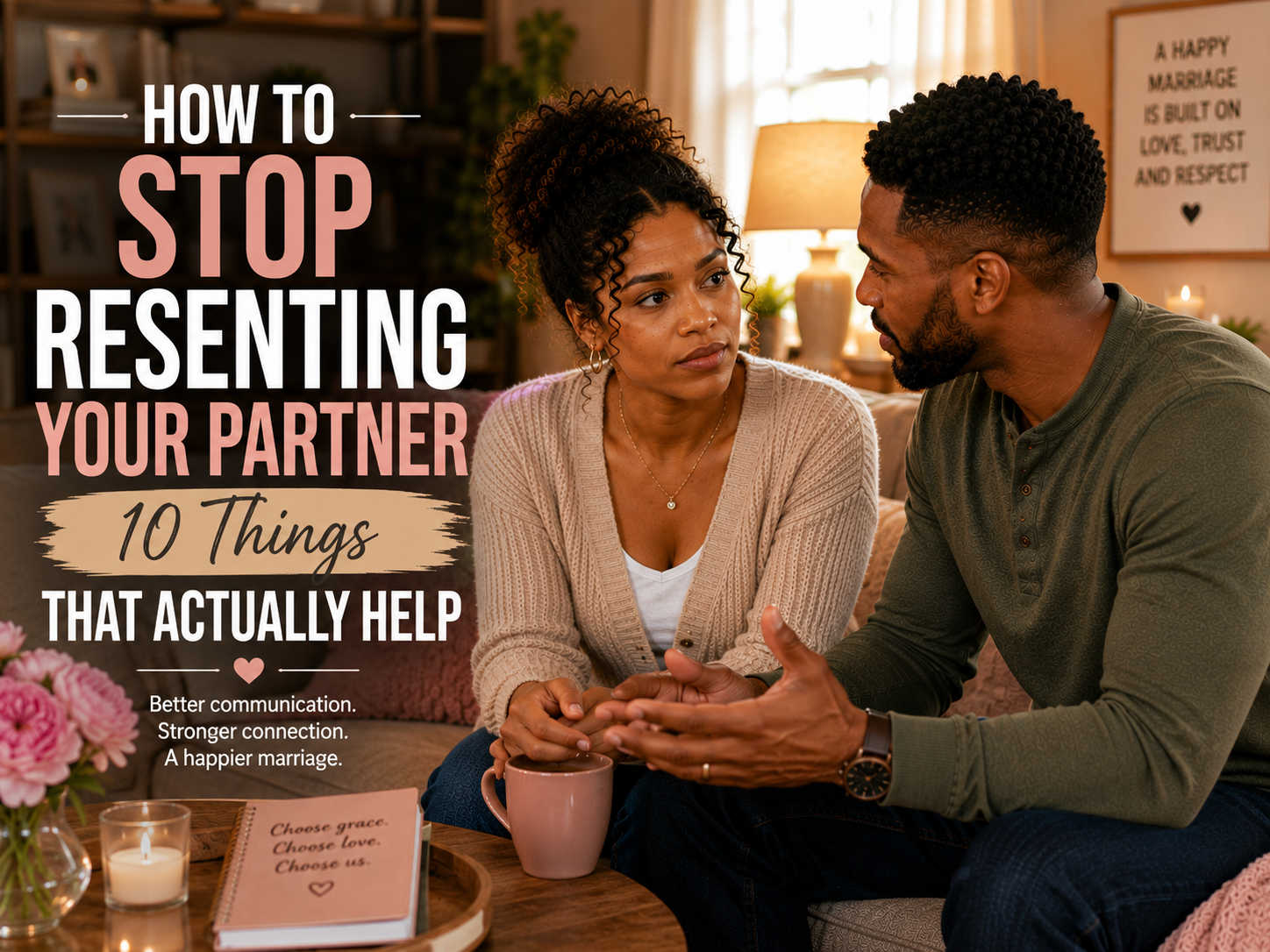
Have you ever looked at your husband and thought, “I love him, but I’m so tired of feeling this way?”
Maybe you’re carrying anger from something he did months ago.
Maybe you feel like you give more than you receive.
Maybe you keep asking for the same things, but nothing seems to change.
Or perhaps the resentment has been building so slowly that you cannot even remember exactly when it started.
This is more common than many women realize.
Resentment in a marriage usually does not appear overnight. It often grows from small disappointments that are never properly addressed.
One forgotten promise becomes another.
One unresolved argument becomes five.
One moment of feeling unappreciated becomes a pattern.
Eventually, you may find yourself irritated by things that would not have bothered you before.
The good news is that resentment does not automatically mean your marriage is over.
But it does mean something needs attention.
If you’re wondering how to stop resenting your husband or partner, the answer isn’t simply to “forget about it” or pretend everything is fine.
You need to understand where the resentment comes from, communicate honestly, and decide what needs to change.
Here are 10 things that can help.
1. Be Honest About What You’re Actually Resenting
Before you can let go of resentment, you need to identify what created it.
Sometimes we say, “I’m just angry with him.”
But anger is often only the surface emotion.
Underneath it may be:
- Feeling ignored
- Feeling unappreciated
- Feeling emotionally abandoned
- Feeling financially overwhelmed
- Feeling like you do everything
- Feeling disrespected
- Feeling unheard
- Feeling taken for granted
- Feeling disappointed by broken promises
- Feeling like your needs always come last
Take some quiet time and ask yourself:
“What exactly am I still angry about?”
Be specific.
Instead of saying, “He doesn’t care about me,” try:
“I feel resentful because I have repeatedly asked for more help around the house and nothing has changed.”
Specific problems are easier to address than general frustration.
2. Stop Pretending You’re Fine When You’re Not

One of the fastest ways to build resentment is to repeatedly say, “It’s okay,” when it isn’t.
You don’t want to start an argument.
You don’t want to seem difficult.
You don’t want to complain.
So you stay quiet.
But silence doesn’t necessarily make the problem disappear.
Sometimes it simply pushes the frustration deeper.
Then one day, something small happens and you explode.
Your partner may wonder why you’re suddenly so angry about something that seems insignificant.
But to you, it isn’t about that one thing.
It’s about everything that came before it.
Healthy communication means allowing yourself to say, “This hurt me,” before the hurt becomes bitterness.
3. Talk About the Problem Without Attacking His Character

There is a big difference between saying:
“You never care about me.”
and saying:
“I’ve been feeling alone lately, and I need us to spend more intentional time together.”
The first statement attacks his character.
The second explains your experience.
When you’re trying to stop resentment from damaging your marriage, focus on the behavior and its impact.
Talk about what happened.
Explain how it made you feel.
Then explain what you need going forward.
For example:
“When I have to handle everything myself, I feel overwhelmed and unsupported. I need us to divide these responsibilities more fairly.”
That gives your partner something specific to understand and respond to.
4. Don’t Keep a Secret Scorecard
This one can be difficult.
When you’re hurt, you may start keeping track.
“I did this, but he didn’t.”
“I apologized first last time.”
“I always initiate.”
“I helped his family, but he didn’t help mine.”
Over time, your relationship can start feeling like a competition.
Who gives more?
Who sacrifices more?
Who apologized first?
Who cares more?
Keeping score rarely creates closeness.
That doesn’t mean you should ignore genuine inequality.
If one person consistently carries an unfair share of the emotional, financial, household, or parenting responsibilities, that needs to be addressed.
But there is a difference between addressing an imbalance and mentally collecting evidence against your partner every day.
Talk about the pattern instead of keeping a private scoreboard.
5. Ask for Specific Changes
One common problem in relationships is expecting your partner to know what you need without telling him clearly.
You might think:
“If he really loved me, he would know.”
But people don’t always experience love in the same way.
Your husband may genuinely believe he is showing love while you are still feeling neglected.
Instead of saying:
“You need to do better.”
try saying:
“I would really appreciate it if you handled bedtime twice a week.”
Or:
“I need us to have one evening each week where we spend time together without our phones.”
Or:
“When I’m telling you about something that upset me, I need you to listen before trying to fix it.”
Specific requests are easier to understand and easier to act on.
6. Look at Whether the Resentment Is Connected to Feeling Unappreciated
Sometimes resentment isn’t really about the task.
It’s about what the task represents.
Maybe you aren’t angry because you had to clean the kitchen.
You’re angry because you feel like nobody notices how much you do.
Maybe you’re not upset because your husband worked late.
You’re upset because you feel like work always seems to come before you.
Maybe you’re not angry because he forgot an anniversary.
You’re hurt because it made you wonder whether the relationship still matters to him.
Feeling appreciated matters.
If this is part of what you’re experiencing, it may help to read:
How to Feel Appreciated Again in Your Marriage
The goal isn’t to demand constant praise.
It’s to create a relationship where both people recognize each other’s effort.
7. Learn the Difference Between Forgiveness and Ignoring the Problem
Forgiveness is often misunderstood.
Some people think forgiveness means saying:
“It doesn’t matter anymore.”
But sometimes it still matters.
Forgiveness does not require you to pretend something didn’t hurt.
It also doesn’t mean accepting the same behavior repeatedly.
You can forgive someone while still having boundaries.
You can love someone while telling them that a particular behavior cannot continue.
And you can decide to release anger without deciding to remain in an unhealthy situation.
If the resentment comes from something serious, ask yourself:
Has the problem actually been addressed, or am I simply being expected to move on?
There is a difference.
8. Rebuild Emotional Connection
Resentment tends to grow when emotional connection disappears.
When couples stop talking deeply, laughing together, touching affectionately, spending quality time together, or showing curiosity about each other’s lives, they can slowly become roommates instead of partners.
You don’t always need a dramatic romantic gesture to reconnect.
Start small.
Ask about his day.
Share something that made you laugh.
Sit together without your phones.
Take a walk.
Have dinner together.
Talk about something other than bills, chores, work, or children.
If you feel emotionally disconnected from your husband, you may also find this helpful:
How to Bring Back Emotional Connection in Your Marriage
Connection doesn’t erase legitimate problems.
But emotional closeness can make difficult conversations easier to have.
9. Take Responsibility for Your Own Emotional Health
Your partner should care about your feelings.
But your entire emotional well-being cannot rest on whether he validates you perfectly every day.
If you have stopped doing things you enjoy, abandoned your friendships, neglected your goals, or made your entire world revolve around the relationship, resentment can become even heavier.
Make room for yourself again.
Spend time with people who make you feel good.
Return to hobbies you enjoy.
Work toward personal goals.
Take care of your physical and emotional needs.
Create moments in your life that belong to you.
This isn’t about becoming distant from your husband.
It’s about remembering that you are a whole person outside your marriage.
10. Decide What Needs to Change—and What You Need to Release
This may be the hardest step.
Some things need to change.
Other things need to be released.
If you continue holding onto every mistake your husband has ever made, your marriage will have very little room for peace.
But if you’re constantly “letting things go” while your partner continues hurting you, resentment will probably return.
So ask yourself:
“What needs to change?”
Then ask:
“What am I willing to stop carrying?”
Maybe you need a serious conversation about finances.
Maybe household responsibilities need to be redistributed.
Maybe you need more affection.
Maybe there are old arguments that need closure.
Maybe you need stronger boundaries.
Maybe you need to stop expecting perfection.
Knowing the difference between these things can change everything.
What If You’ve Already Tried Talking to Your Husband?
This is where things become more complicated.
Sometimes resentment continues because you’ve already communicated your concerns several times.
You’ve explained how you feel.
You’ve asked for changes.
You’ve tried being patient.
And nothing seems different.
If that’s your situation, don’t automatically blame yourself for still feeling resentful.
Ask whether your partner is actually participating in the solution.
A healthy relationship requires effort from both people.
You can communicate beautifully and still not be able to create change by yourself.
Look for actions, not just promises.
Is he listening?
Does he acknowledge your concerns?
Does he make an effort?
Does he take responsibility?
Does he follow through?
Does he care about how his behavior affects you?
Those questions can tell you more than a single apology.
What If Your Resentment Comes From Money?

Money can create enormous tension between couples.
One partner may spend freely while the other is constantly trying to save.
One may contribute significantly more financially.
One may feel responsible for every bill.
Or you may feel like you’re financially supporting your husband while your own needs and goals are being neglected.
If money is at the center of your resentment, don’t allow the conversation to become another argument about who is “bad with money.”
Instead, sit down and talk about:
- Income
- Expenses
- Debt
- Savings
- Financial responsibilities
- Spending expectations
- Short-term goals
- Long-term goals
- Individual financial independence
You may also want to read:
How to Talk to Your Husband About Money Without Fighting
The goal isn’t simply to stop fighting about money.
It’s to create a financial system that feels fair to both people.
What If Resentment Has Already Changed the Way You See Him?
This is an important warning sign.
When resentment becomes deeply rooted, you may begin interpreting almost everything your partner does negatively.
He comes home late, and you assume he doesn’t care.
He forgets something, and you think, “Of course he did.”
He tries to help, and you wonder why he didn’t do it sooner.
Even his attempts to make things better may irritate you.
This doesn’t necessarily mean you’re incapable of loving him.
It may mean you’ve accumulated so much unresolved hurt that your emotional response is now shaped by the past.
That’s why resentment deserves attention before it becomes permanent emotional distance.
If you’re also noticing constant conflict, withdrawal, or emotional disconnection, take a closer look at the overall health of your marriage.
You may find this helpful:
How to Know When Your Marriage Needs More Attention
A Simple Exercise for Couples

If both of you are willing, try this exercise.
Sit somewhere quiet and take turns answering three questions:
1. What is one thing I currently feel hurt about?
Be honest without attacking.
2. What is one thing I wish my partner understood about me?
This allows each person to explain the emotional meaning behind the problem.
3. What is one small change we can make this week?
Keep it realistic.
Don’t try to solve ten years of problems in one evening.
One meaningful change repeated consistently can be more powerful than one emotional conversation followed by no action.
When Resentment Is a Sign of a Bigger Problem
Not every relationship problem can be solved by better communication.
If your partner repeatedly humiliates you, manipulates you, threatens you, controls your money, isolates you, intimidates you, or makes you feel unsafe, the issue may be bigger than ordinary marital resentment.
You don’t have to minimize harmful behavior simply because you are married.
Your emotional and physical safety matters.
In situations involving abuse or coercive control, consider seeking support from a trusted person or qualified professional who can help you think through your options safely.
Final Thoughts
Learning how to stop resenting your husband isn’t about forcing yourself to stop feeling angry.
Your feelings are telling you something.
Listen to them.
Ask where the resentment came from.
Talk about what hurt you.
Be specific about what you need.
Set reasonable boundaries.
Pay attention to whether your partner is willing to participate in creating change.
And at the same time, give yourself permission to release the things that no longer need to control your heart.
A healthy marriage doesn’t mean two people never hurt each other.
It means they are willing to notice the hurt, take responsibility, repair what they can, and keep choosing healthier ways to love each other.
You deserve to feel heard in your marriage.
You deserve to feel respected.
You deserve to feel appreciated.
And your marriage should have room for your feelings—not just your sacrifices.
Frequently Asked Questions
Why do I resent my husband so much?
Resentment often develops when unresolved hurt, disappointment, unequal effort, poor communication, feeling unappreciated, financial stress, or repeated broken promises accumulate over time. Identifying the specific source of resentment is an important first step.
Can resentment ruin a marriage?
Yes. Unresolved resentment can create emotional distance, frequent arguments, withdrawal, and loss of affection. Addressing resentment early can give couples a better chance of rebuilding connection.
How do I stop being angry at my husband?
Start by identifying what you’re actually angry about. Then communicate the specific issue, explain how it affects you, decide what needs to change, and determine what you are willing to forgive and release.
Should I forgive my husband if he keeps hurting me?
Forgiveness does not require you to accept repeated harmful behavior. You can forgive while maintaining boundaries and expecting meaningful change.
How long does it take to get over resentment in a relationship?
There is no fixed timeline. It depends on the cause of the resentment, how long it has existed, whether the underlying problem is addressed, and whether both partners are willing to make changes.
What if my husband doesn’t care that I’m resentful?
You cannot control whether another person changes. If you’ve clearly communicated your concerns and nothing improves, consider what boundaries you need and what you are willing to accept in the relationship.
0 Comments