
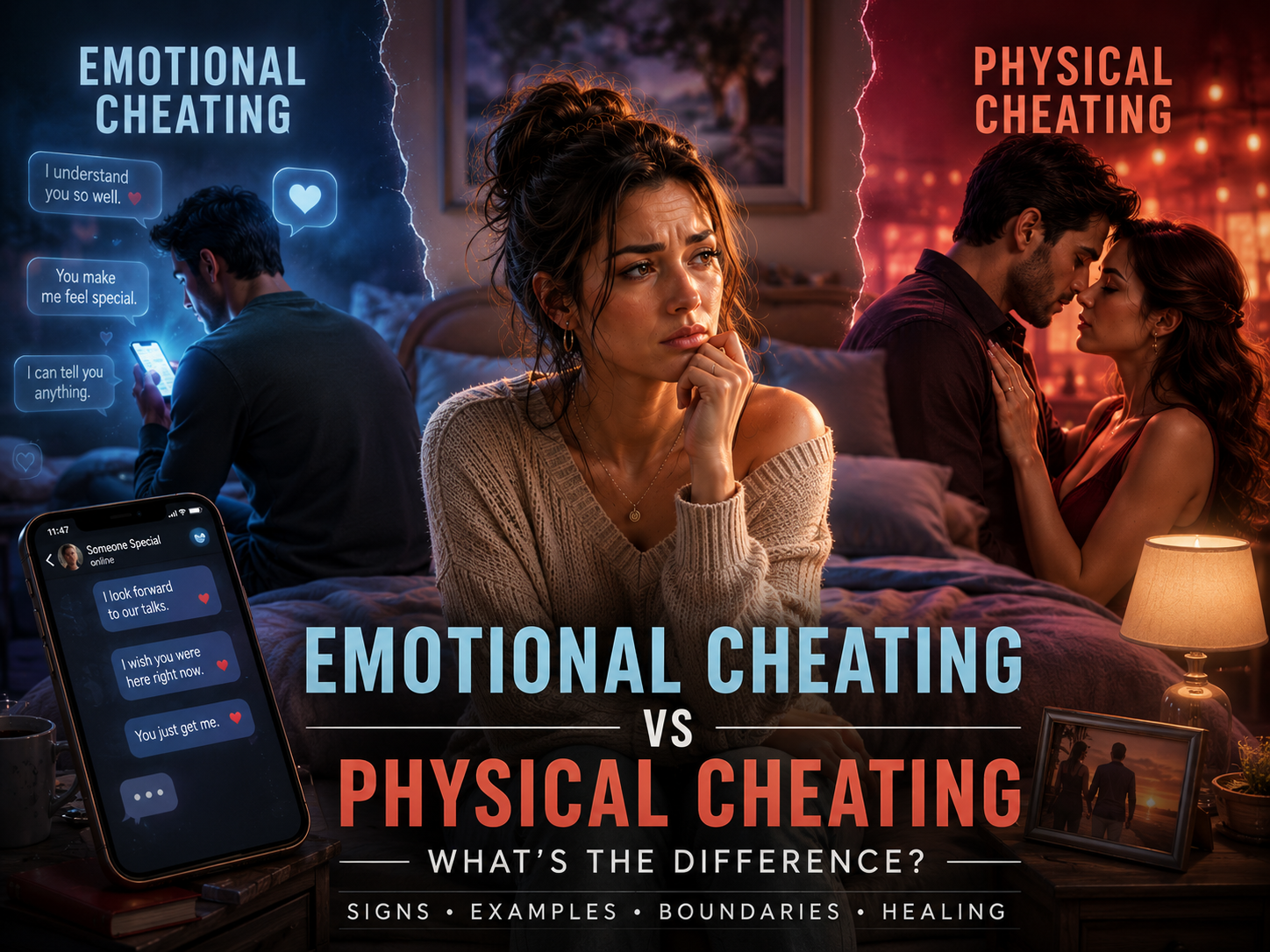
When people hear the word cheating, they often imagine a physical affair.
A secret kiss.
A sexual relationship.
A hidden meeting.
But not every betrayal begins with physical intimacy.
Sometimes it begins with conversations.
Late-night messages.
A secret friendship.
Sharing emotional experiences with someone outside the relationship.
Feeling more understood by another person than by your partner.
And slowly creating an emotional connection that your partner doesn’t know about.
This raises an important question:
Is emotional cheating really cheating?
And how is it different from physical cheating?
The answer isn’t always simple.
Every relationship has different boundaries. But there are some important differences between emotional and physical infidelity—and understanding them can help you recognize when an innocent friendship may have crossed a line.
Let’s break it down.
What Is Emotional Cheating?

Emotional cheating generally refers to developing a close emotional connection with someone outside your relationship in a way that violates the expectations or boundaries of your partnership.
It may not involve physical intimacy.
Instead, the betrayal can involve secrecy, emotional intimacy, romantic feelings, or giving another person a level of attention and connection that would normally belong within the relationship.
For example, imagine someone begins talking regularly to a coworker.
At first, everything seems innocent.
They talk about work.
Then personal problems.
Then relationship problems.
Eventually, that coworker becomes the first person they want to tell when something exciting or upsetting happens.
They start hiding the conversations from their partner.
The relationship may still look like “just friendship” from the outside.
But emotionally, something has changed.
The problem isn’t necessarily that they have a friend.
It’s that the relationship has become secretive, emotionally intimate, or romantic in a way that crosses their relationship’s boundaries.
What Is Physical Cheating?

Physical cheating generally involves romantic or sexual physical intimacy with someone outside the agreed boundaries of a relationship.
Depending on the couple’s boundaries, this might include:
- kissing
- sexual touching
- sexual activity
- romantic physical intimacy
- secret sexual encounters
Physical infidelity can be especially painful because it involves a physical violation of trust.
But the emotional impact can vary from person to person.
Some people are more devastated by physical betrayal.
Others find emotional betrayal even more painful.
And some experience both at the same time.
Emotional Cheating vs Physical Cheating: The Main Difference
The simplest distinction is this:
Physical cheating involves physical or sexual intimacy outside the relationship.
Emotional cheating involves an inappropriate or secret emotional attachment outside the relationship.
But there can be overlap.
An emotional affair can eventually become physical.
A physical affair can also involve a deep emotional attachment.
That’s why focusing only on whether physical intimacy occurred can sometimes miss the bigger issue.
The deeper question is:
Has a relationship boundary been crossed?
7 Examples of Emotional Cheating
Not every close friendship is emotional cheating.
Healthy friendships can exist inside healthy relationships.
The issue is usually the combination of secrecy, emotional intimacy, romantic interest, and boundary violations.
Here are some examples.
1. Sharing Things With Someone Else That You Hide From Your Partner
Your partner may have a friend they tell everything to—but deliberately hide the depth of the relationship from you.
The secrecy becomes part of the problem.
2. Turning to Someone Else for Emotional Intimacy
When another person becomes the primary source of emotional comfort, validation, excitement, or support, the relationship may begin competing with the primary partnership.
3. Flirting Through Private Messages
Occasional friendliness isn’t necessarily cheating.
But repeated romantic or sexual flirting that is intentionally hidden can cross a relationship boundary.
4. Talking About Your Relationship Problems With Romantic Intent
There is nothing inherently wrong with seeking advice.
But repeatedly discussing intimate relationship problems with someone who has romantic interest in you can create emotional closeness that goes beyond friendship.
5. Hiding Notifications or Messages
If someone suddenly becomes protective of their phone because they don’t want their partner to see conversations with a particular person, secrecy may be worth examining.
6. Looking Forward to One Person More Than Your Partner
If someone becomes emotionally excited about communicating with another person while becoming increasingly disconnected from their partner, the emotional relationship may have become significant.
7. Developing Romantic Feelings
This is one of the clearest examples.
If someone begins thinking about another person romantically, imagining a relationship with them, or emotionally investing in that possibility while remaining in their current relationship, a significant boundary may have been crossed.
7 Examples of Physical Cheating
Physical infidelity can also take different forms depending on the boundaries established within the relationship.
Examples can include:
1. Secret Kissing
A romantic kiss outside the relationship can violate a couple’s agreed boundaries.
2. Sexual Touching
Sexual physical contact with another person may constitute physical cheating.
3. Sexual Encounters
Secret sexual activity outside the relationship is a clear example of physical infidelity for relationships that have agreed to exclusivity.
4. Secret Romantic Meetings
A meeting isn’t automatically cheating.
But secretly meeting someone with romantic or sexual intentions can become part of an affair.
5. Maintaining a Secret Physical Relationship
When physical intimacy happens repeatedly and is deliberately hidden, the betrayal involves both the physical behavior and the deception surrounding it.
6. Combining Physical and Emotional Intimacy
Sometimes a physical affair develops alongside strong emotional attachment.
This can make the betrayal especially complicated.
7. Continuing Physical Contact After Promising to Stop
If someone has already acknowledged that a relationship crossed boundaries and then continues the physical relationship secretly, the repeated deception becomes another major part of the betrayal.
Can Emotional Cheating Be Worse Than Physical Cheating?
There isn’t one answer.
Different people experience betrayal differently.
For some people, physical cheating is the most painful part.
For others, emotional cheating hurts more because it feels like their partner gave someone else their heart, attention, and emotional intimacy.
Someone may think:
“I could understand a physical mistake, but I can’t understand why you built a relationship with someone else.”
Another person may feel exactly the opposite.
Neither response is automatically wrong.
What matters is understanding what the betrayal means within the specific relationship.
Why Emotional Cheating Can Hurt So Much
Emotional cheating can be particularly painful because it may involve a gradual transfer of emotional intimacy.
Your partner may be:
- sharing personal secrets
- seeking emotional comfort
- discussing their dreams
- talking about relationship problems
- looking for validation
- becoming emotionally dependent on someone else
You may begin wondering:
“What did they share with that person that they stopped sharing with me?”
That question can hurt deeply.
The betrayal isn’t necessarily about one physical moment.
It can feel like watching an emotional relationship grow while you were kept outside of it.
Can Emotional Cheating Turn Into Physical Cheating?
Yes, it can.
But it doesn’t always.
Some emotional relationships remain emotional.
Others gradually become romantic or physical.
That is one reason boundaries matter.
A relationship may start with:
“We’re just friends.”
Then become:
“We talk every day.”
Then:
“I tell them things I don’t tell you.”
Then:
“I don’t want you to know how close we are.”
The progression isn’t always identical.
But secrecy and increasing intimacy can make a previously innocent relationship more complicated.
When Does a Friendship Cross the Line?

This is where things become difficult.
Having friends isn’t cheating.
Talking to coworkers isn’t cheating.
Having emotional support outside your relationship isn’t automatically cheating.
Healthy relationships allow people to maintain friendships and individual identities.
The question is whether the friendship has crossed your relationship’s boundaries.
Ask:
Would my partner be comfortable seeing these conversations?
Am I hiding the relationship?
Would I behave differently if my partner were standing beside me?
Have romantic feelings developed?
Am I giving this person emotional intimacy that is damaging my relationship?
Would I be upset if my partner behaved exactly the same way with someone else?
These questions can reveal whether a friendship has moved beyond healthy boundaries.
Is Emotional Cheating Still Cheating If Nothing Physical Happened?
It can be.
Whether a particular behavior qualifies as cheating depends partly on the boundaries the couple has established.
One couple may consider private flirting a serious betrayal.
Another couple may have different expectations.
The important issue is not whether every relationship has exactly the same definition.
It’s whether someone knowingly violates the relationship’s boundaries and then hides it.
A person doesn’t necessarily have to have sex with someone else for their partner to feel betrayed.
Signs a Friendship May Have Become Emotional Cheating
Here are some warning signs worth paying attention to:
The relationship is being hidden
Your partner becomes unusually secretive about the person.
The communication is constant
They communicate throughout the day and seem emotionally preoccupied with the relationship.
They delete messages
Messages disappear because they don’t want you to see them.
They become defensive
Reasonable questions are met with anger or accusations.
They compare you to the other person
The outside person increasingly becomes a source of comparison.
They share intimate details about your relationship
Private relationship information is repeatedly shared with the outside person.
They become emotionally distant from you
Their emotional attention appears to be moving elsewhere.
One sign alone doesn’t necessarily prove an affair.
Look at the overall pattern.
What to Do If You Discover Emotional Cheating

Discovering an emotional affair can leave you confused.
You may wonder whether you’re overreacting.
You may question whether it “counts.”
You may even blame yourself for being jealous.
Before making a major decision, give yourself time to understand what happened.
Start by asking:
What exactly happened?
How long has this relationship existed?
Was it hidden?
Were romantic feelings involved?
Were boundaries discussed before?
Is your partner willing to be honest about it?
You don’t have to make a permanent relationship decision in the middle of emotional shock.
What to Do If You Discover Physical Cheating
Physical cheating can create an intense emotional reaction.
You may feel anger, sadness, disbelief, or humiliation.
Try not to make your entire future decision based on the first few hours or days after discovering the betrayal.
Instead, gather the information you need.
Consider:
- What happened?
- Was it a one-time event or repeated?
- Has the physical relationship ended?
- Is your partner taking responsibility?
- Are they willing to answer reasonable questions?
- Are they willing to make changes?
- What do you need to feel safe?
If you’re trying to determine whether your partner has actually stopped cheating, see:
How to Tell If Your Partner Has Actually Stopped Cheating
Can a Relationship Recover From Emotional Cheating?
It can be possible.
But recovery usually requires more than simply ending the outside relationship.
The couple may need to address:
- honesty
- boundaries
- communication
- accountability
- emotional disconnection
- trust
- unmet relationship needs
If both partners genuinely want to repair the relationship, rebuilding may take time.
For practical guidance on rebuilding trust, read:
How to Rebuild Trust After Cheating: 9 Things That Actually Help
Can a Relationship Recover From Physical Cheating?
Some couples do recover after physical infidelity.
But recovery isn’t guaranteed.
It often depends on what happens after the betrayal.
Is the cheating actually over?
Is the person who cheated taking responsibility?
Are both partners willing to address the damage?
Are boundaries being respected?
Is trust gradually returning?
If you’re questioning whether your relationship can survive infidelity, you may also want to read:
Can a Relationship Survive After Cheating? 10 Questions to Ask
Emotional Cheating and Physical Cheating Can Happen Together
It’s important not to assume that emotional and physical cheating are always separate categories.
An affair can contain both.
A person may first develop an emotional connection and later become physically intimate.
Or physical intimacy may happen without a significant emotional relationship.
Either way, the secrecy and betrayal can create serious damage.
That’s why asking:
“Which one is worse?”
may not always be the most useful question.
A better question may be:
“What happened to the trust and boundaries in this relationship, and what would need to change?”
How to Set Healthier Relationship Boundaries

One of the best ways to reduce confusion around emotional and physical cheating is to discuss boundaries before a crisis happens.
Talk openly about:
Friendships
What feels appropriate with friends?
Private messaging
Are there types of conversations that feel inappropriate?
Flirting
What does each partner consider flirting?
Ex-partners
What kind of contact is acceptable?
Emotional intimacy
What does emotional exclusivity mean to each of you?
Secrecy
What kinds of information should never be hidden?
Social media
Are there behaviors online that either person considers disrespectful?
You don’t need identical opinions.
You do need honest communication.
What Matters Most After Betrayal?
Whether the cheating was emotional, physical, or both, the aftermath matters.
Look at behavior.
Is your partner honest?
Are they accountable?
Are they willing to discuss boundaries?
Are they willing to rebuild trust?
Are they making consistent changes?
If you’re struggling to determine whether an apology is genuine, read:
How to Know If Your Partner Is Truly Sorry for Cheating
The goal isn’t simply to decide what label belongs to the betrayal.
The goal is to understand what happened and decide what you need moving forward.
Final Thoughts
So, what’s the difference between emotional cheating and physical cheating?
Emotional cheating involves a secretive or inappropriate emotional connection that crosses relationship boundaries.
Physical cheating involves romantic or sexual physical intimacy outside the relationship.
But the most painful part of either type of betrayal may not be the label.
It may be the loss of trust.
The secrecy.
The feeling that your partner gave something important to someone else.
And the uncertainty about whether you can feel safe in the relationship again.
If you’ve discovered something that feels like cheating, don’t pressure yourself to immediately decide whether you’re overreacting.
Take time to understand what happened.
Look at the pattern.
Think about the boundaries you and your partner agreed to.
And most importantly, pay attention to what happens next.
Because betrayal may change a relationship.
But what happens after the betrayal can tell you a great deal about whether trust can eventually be rebuilt.
Frequently Asked Questions
What is the difference between emotional cheating and physical cheating?
Emotional cheating generally involves an inappropriate or secret emotional connection with someone outside the relationship, while physical cheating involves romantic or sexual physical intimacy outside the relationship.
Is emotional cheating considered cheating?
It can be. Whether something qualifies as cheating depends partly on the boundaries established within a relationship. Secrecy, romantic feelings, inappropriate emotional intimacy, and deliberate boundary violations can make an outside relationship especially concerning.
Is emotional cheating worse than physical cheating?
There is no universal answer. Some people find physical betrayal more painful, while others consider emotional betrayal more damaging because of the emotional intimacy involved.
Can emotional cheating turn into physical cheating?
Yes, although it doesn’t always happen. Some emotional relationships remain emotional, while others gradually develop into romantic or physical relationships.
Can you have an emotional affair without realizing it?
It’s possible for boundaries to develop gradually. A relationship that begins as a normal friendship can become increasingly intimate or secretive over time.
Is texting someone else cheating?
Texting alone isn’t necessarily cheating. The context matters. Secret romantic conversations, sexual messages, emotional dependency, or deliberately hiding communication can violate relationship boundaries.
Can a relationship survive emotional cheating?
Some relationships can recover, especially when both partners are willing to address the betrayal, improve communication, establish boundaries, and rebuild trust.
What should I do if my partner is emotionally cheating?
First, give yourself time to process what you’ve discovered. Then try to understand the nature of the relationship, communicate your concerns, establish boundaries, and decide what you need before making major decisions.
0 Comments